One of the biggest challenges facing democracies is the growing role of money in elections.
India has been wrestling with the problem for decades. During the 2014 parliamentary elections politicians jointly spend an estimated 5 billion dollars. As the spending increases every election, this amount will likely be even surpassed in the upcoming 2019 elections. These extravagant campaign costs are worrisome, for a range of reasons. High campaign expenses foster corruption, threaten the quality of governance and undermine the fairness of the electoral process. Rich candidates or candidate with wealthy backers are at an advantage while poor but capable candidates are discouraged from even running for elections. These campaign costs also foster collusive deal-making between politicians and business actors, who expect to be compensated for their campaign contributions with licenses, contracts and other favors. As a result, discontent and worries about the high costs of elections are regularly animating newspaper commentaries, as well as a number of recent policy initiatives from Modi’s government.
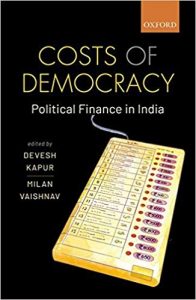
In that light it was high time that scholars of Indian politics pay more sustained attention to political finance. In bringing together a varied and insightful set of essays in a highly readable edited volume, Devesh Kapur and Milan Vaishnav have done a great service to both scholars of Indian politics as well as New Delhi’s policymakers. By bringing together a group of experienced and knowledgeable scholars employing a refreshing mix of research methods, Costs of Democracy succeeds in providing a comprehensive overview of the policies, character and effects of political finance in India. Through a combination of thorough on-the-ground ethnographic accounts, clear-headed policy analyses as well as overview studies based on surveys, election data and even cement consumption statistics, the book discusses not only the various ways in which politicians put money to use during elections, but also the ways in which policy-making could address the resulting threats to India’s democracy.
The resulting picture is both fascinating and gloomy. The fascinating part concerns the creative strategizing that surrounds the use of money in Indian elections. Money, as the articles in this book show, shapes politics in stunningly wide-ranging ways. Neelanjan Sircar discusses the role of money in candidate selection, highlighting that political parties – out of concern for meeting campaign expenses – are inclined to select wealthy candidates. Other essays highlight the kinds of collusive dealmaking that campaign financing generates – from exchanges between builders and politicians – the focus of Devesh Kapur and Milan Vaishnav’s essay – to the flows of money between politicians and various kinds of brokers and ‘social workers’ (Björkman and Witsoe’s piece). Particularly fascinating is also Collins account of how the need for campaign finance forces a poor political party in Tamil Nadu (the VCK) into a dependent relationship with a richer political party (the AIADMK). This party pays for VCK’s campaign costs in exchange for political subservience. Similarly fascinating are the accounts of the various ways money is used. Simon Chauchard uses his ethnographic fieldwork to provide a particularly rich overview, providing at one point a list of forty different types of expenditures, ranging from using money to put up dummy candidates, to hiring trucks to ferry voters, giving money to journalists to ensure favourable reporting, to ‘work money’ – i.e. the wages paid to campaign organizers.
Considerable attention is paid to vote buying, i.e. the practice of handing out money and consumer goods during election campaigns. Several authors conclude that this practice is increasingly common, and contributing greatly to the overall costs of election campaigns. Particularly Björkman and Witsoe make the point that this practice should not be seen as simple marketplace-like purchase of the vote. The picture that emerges from this book is that vote buying is a complex (and expensive) form of political advertisement. The gifts of money to voters not only serve to convey the candidates concern and care for individual voters, but the distribution of these gifts also play an important role in building social networks, and signaling their strength: the distribution of money through a local broker shows voter that this broker has a close and therefore useful connection to the candidate. Because of these and other observations, this book makes for highly recommended reading for people wanting to understand the nature of election campaigns in India.
But the book also paints a gloomy picture. The book makes a convincing case that the costs of elections in India have spiraled out of control, with considerable negative effects for both the functioning of government institutions as well as the quality of India’s democracy. This is apparent, for example, in Jennifer Bussell’s insightful essay. She surveyed local politicians about (their perception of) the provenance of their own campaign budgets as well as that of their rivals. Unsurprisingly, politicians consider their own budgets to be relatively clear while providing damning and worrying assessments of the political finance of their rivals: Bussell’s survey suggest that ‘black money’ – i.e. illegal, often criminal funding sources – is considered to be the most common source of campaign finance in parliamentary elections. Bussell’s essay, as well as particularly Collins’ and Sircar’s articles show that high campaign costs make it easy for well-endowed actors to influence the political process, while limiting the power of marginalized groups. The main take-away of this book is, therefore, in order to improve the quality of democracy (in India as well as elsewhere) we more extensive efforts are needed to control the role of money in elections.
In that light it is fitting that the book also pays considerable attention to the policies regarding political finance. As the overview piece by Sridharan and Vaishnav shows, policies to regulate political finance are in place. But they are generally flouted as spending caps are unrealistically low and India’s Election Commission lacks the manpower to effectively monitor campaigns or to check on the financial reports that politicians submit after their campaigns. Kapur, Sridharan and Vaishnav end the book with a set of policy recommendations that might serve to address such problems, and reduce the role of money in elections in electoral. They recommend measures to improve transparency in campaign financing, and a bigger role of public financing, coupled with incentives for small individual campaign donations. While having their own challenges, these recommendations,make sense. The prominence of money in elections is not an unavoidable, natural phenomenon, it is something that can and should be brought under (some levels of) control.
The book is unlikely to be the final word on political finance in India. As the editors point out, in this relatively young academic debate much remains unknown. For example, even between the authors of the book debates rage about whether candidates rely mostly on their own personal finances (Sircar’s position) or on outside contributions (Bussell’s argument). Similarly, this book could not really touch on whether and to what extent there is variation in money politics and vote buying across Indian states. Thirdly, the book does not really get into the broader effects of high-cost elections on policymaking and governance. To what extent the political importance of money is enabling economic elites to bend the Indian state to its will? What do campaign donors ask and receive in return for their financial contributions? Having studied politics in Southeast Asia where ‘oligarchic politics’ is a more prominent trope of analysis, we would expect that such questions will become even more urgent in the coming years. In that light, we can only hope that other researchers will take up the torch that the authors of this edited volume have lit.
Review of Costs of Democracy: Political Finance in India. Edited by Devesh Kapur and Milan Vaishnav. New Delhi: Oxford University Press, 2018. 311 pages, 750 rps.
Co-authored with Sarthak Bagchi, this review first appeared in The Book Review


This is a strong and important analysis, and I agree with the central argument that money is no longer just a supporting factor in politics, it is shaping the entire structure of democratic competition.
What stands out most, however, is that this is not a problem unique to India. It is a global phenomenon, and the Indian case simply makes it more visible because of its scale and complexity.In the United States, there is a saying that captures this reality quite bluntly: America has the best democracy that money can buy.
Campaigns are extraordinarily expensive, and access to political power is often tied to fundraising capacity. While the system is more regulated and transparent on paper, the influence of wealthy donors and organized interests remains significant. This raises similar concerns about representation, accountability, and whose voices ultimately shape policy outcomes.
Kenya offers another revealing example. It is widely understood that it can cost around $200,000 to win a seat in Parliament, a figure that immediately excludes large segments of the population from political participation. In many emerging democracies, including Kenya, money plays a dual role. It is not only a tool for campaigning but also a signal to voters.
Candidates who spend heavily are often perceived as more capable of delivering services once elected. Voters expect tangible returns, and campaign spending becomes a form of demonstration.
The problem is that this expectation reinforces a cycle where politics becomes transactional rather than developmental.When we look at India alongside its neighbors, the similarities are clear, but the mechanisms differ.In India, money has become deeply embedded in party structures and candidate selection.
Political parties often favor wealthy candidates because they can finance their own campaigns, reducing the financial burden on the party. This creates a system where access to power is increasingly tied to personal wealth or financial backing.
It also encourages complex networks of exchange between politicians, businesses, and intermediaries, which can influence governance long after elections are over.In Bangladesh, the issue is somewhat different but equally concerning.
There are formal rules governing campaign spending, but enforcement is weak. Official declarations of campaign expenses are often far lower than what is observed on the ground, suggesting a significant gap between regulation and reality.
This creates an environment where money flows through informal channels, making transparency difficult and accountability even harder to enforce.Pakistan presents yet another variation.
Campaign spending limits exist, but serious candidates often exceed them in practice. Politics in Pakistan is heavily influenced by patronage networks, where financial resources are used to build alliances, secure party nominations, and mobilize voters.
The cost of participation is high, and as a result, politics tends to favor individuals with access to wealth or powerful backers.Across all these cases, a common pattern emerges.Money does not simply influence elections.
It shapes who can run, how campaigns are conducted, and what expectations are created between politicians and voters. It alters the incentives of governance, often pushing leaders to prioritize those who financed their campaigns rather than the broader public.
That is why the issue is so important.It is not just about fairness during elections. It is about the long-term health of democracy. When money becomes the primary gateway to political participation, it narrows representation and weakens the connection between citizens and the state.
The Indian case is a powerful example, but it is also a warning.If left unchecked, the growing role of money in politics can gradually transform democratic systems everywhere, not by abolishing them, but by reshaping them in ways that make them less inclusive, less accountable, and ultimately less responsive to the people they are meant to serve.
LikeLike